Showing posts with label Filipino cuisine. Show all posts

Champorado

Tuesday, July 03, 2007

One of my favourite home-made Filipino desserts is champorado. I'm not sure how this dish got its name, but in English I call it "chocolate rice". Which is pretty much what it is. (I suppose you can call it chocolate rice pudding.)

As a child, I loved the ritual of adding sugar to my bowl of champorado, followed by swirls of milk. My dad used to form our initials when he poured milk ... kind of like coffee art, but low-tech. *lol* I used to make swirls and curls and sometimes I'd try to fit more than one milky initial into my bowl, usually with disastrous effects. I used to love my champorado drenched in milk, but as I grew up, my taste buds adjusted themselves and now I very rarely add milk anymore--yes, even when we used top-notch cocoa and ended up with a very dark result (see below).

In the past few weeks, Mum has been coming over to help out with the new babies--yes, I had twins!--and what better time to absorb all her cooking shortcuts and tips? Yesterday she talked me through how to make this delicious concoction that even Rob, who usually declines chocolate fare--much to my delight since it means I won't have to share my dessert--has at least two helpings whenever champorado is being served.

The timing couldn't be better. Cupping a steaming bowl of champorado, inhaling its delicious aroma, and taking that first spoonful of chocolatey goodness ... what a delightful way to beat the winter chill.
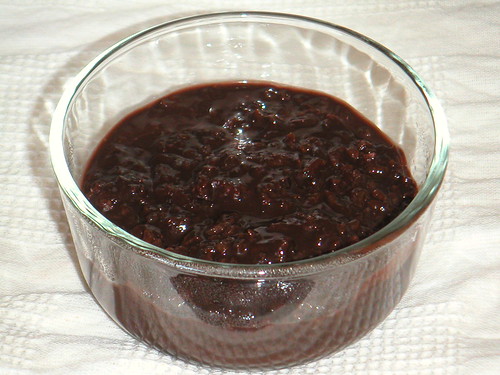
Champorado
1 cup glutinous rice
5 cups water
2 tbsp (heaped) cocoa
2-3 squares cooking chocolate or tablea (optional)
3-4 tbsp (heaped) sugar
milk

  1. Put rice and water in a medium sized saucepan. Cover and place on high heat.
  2. Mix cocoa and sugar in a small bowl. Add hot water to dissolve, and remove lumps. Stir mixture into the saucepan using a wooden spoon.
  3. Add chocolate squares into the saucepan and stir.
  4. When the water boils, reduce the heat to simmer. Simmer for 10-15 minutes, stirring occasionally, until the rice is plump.
  5. Add milk and extra sugar to taste just before serving.
Cooking tips
- The darker the cocoa, the more sugar and milk you'll need. You don't need to use high-quality cocoa. My mum uses the no-name brand and no one has ever complained about the quality of her
champorado.
- Don't skip step 2 or the chocolate will be lumpy.
- The cocoa can be substituted entirely with chocolate squares or tablea (or vice versa), but it may affect the texture of the
champorado. You may need to experiment a bit to get the quantities right.

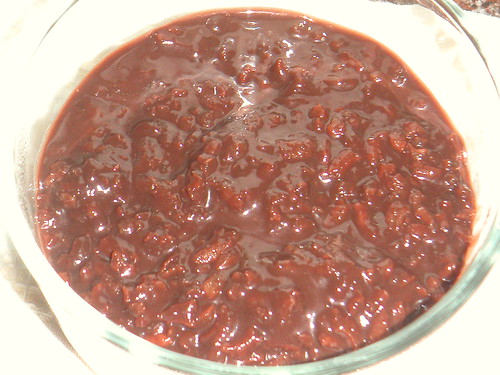
This recipe is usually good enough for about 4 people, but if you love this dessert and haven't had it in a while then 2 people can probably go through the entire recipe within 24 hours. Rob and I fairly inhaled it in one sitting. The picture above shows what was left after we were done. Yes, after one sitting.
Street food

Tuesday, April 10, 2007

I nearly died of delight when I saw these series of pictures over at My Sari-sari Store by Belgian photograper, Sidney Snoeck. No matter how hard we try to recreate some of the best food in the Philippines, there's just no way to replicate the colour, aroma and taste of street food. These take me back to my childhood...

Taho
Hands down, my absolute favourite. On my last visit to Manila, my Tita (Aunt) bought half a dozen cups from the street vendor. I would have eaten them all except that I had to share with my much younger cousins. Fortunately, I can make a pretty close approximation of taho here at home. Still, there's nothing like running to the front door when you hear the magtataho calling out.

Dirty ice cream
I know the name sounds odd and, to be honest, I didn't have any the last time I was in Manila because I was paranoid about getting food poisoning. But dirty ice cream is basically no-name ice cream sold by through street carts. It's like a manual version of the Mr Whippy van!

Bananacue
I'm guessing that this name is a combination of "banana" and "barbeque" because it's basically fried sugar bananas skewered on wooden sticks and coated with caramelised brown sugar. A kind of tropical version of the toffee apple. The main problem with recreating this dessert is finding the right kind of banana to use. We usually go with frozen sugar bananas from the Asian grocery, but they're never really as sweet and juicy as the fresh kind.

Fishballs
This one isn't very difficult to recreate, either, and is one of the most popular wares in any Filipino fiesta (the most popular usually being the pork barbeque--Filipinos will go gaga over those). The sauce makes or breaks a fishballs vendor.

Click here for more street food goodness. Forget about hygiene--it's all about the taste.

Grand Philippine Fiesta 2006

Sunday, October 01, 2006

For the first time ever, I went along to the Grand Fiesta which was held this year at Rosehill Racecourse.

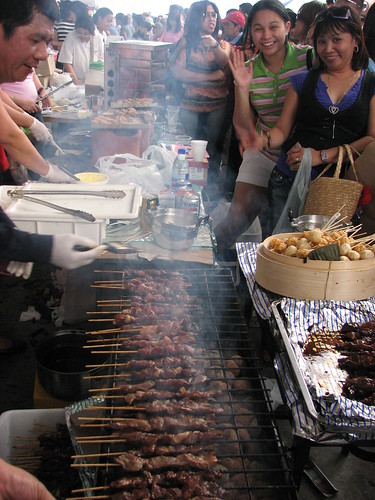
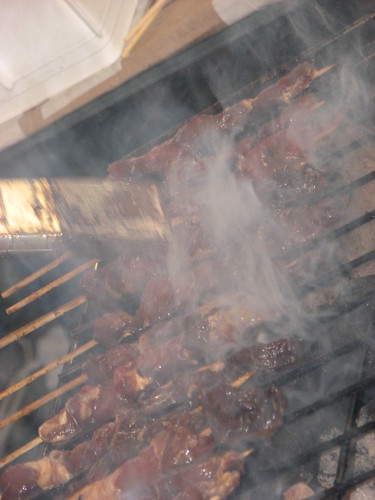
The first thing you notice coming into the event is...the smell of Filipino barbeque. Almost every food stall offered BBQ and a smoky haze permeated Rosehill form about 9am to well after 6pm. I went around the stalls twice to scope out the BBQ and fishballs on sticks, and I wasn't disappointed.

I have to say, though, that my Dad makes better fishball sauce. His home-made sauce has a slight kick of chilli, whereas most Filipino fishball sauces are invariably too sweet for my liking.

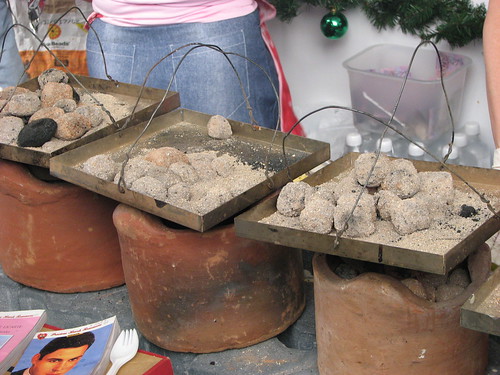
I was manning the Australian Filipina Magazine booth, so I didn't get much time to take food photos, but I did manage to snag me some BBQ and honest to goodness bibingka cooked in traditional charcoal ovens.

Charcoal ovens (check out the trashy romance novels nearby)


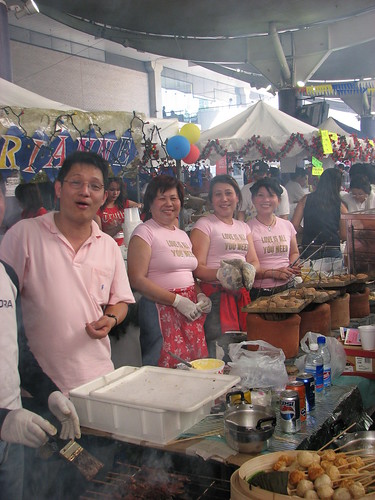
The stall was manned by these cute ladies, whose uniform reminded me of the Pink Ladies in Grease.Traditional bibingka is pretty rare in these parts and the line to get one was HUGE. When we arrived in the morning, I bypassed the stall because there were about 10 people in line. By lunchtime, the line was so long, I was told there would be at least a half hour wait.

Luckily, wandergurl volunteered to line up for me. She was there for about an hour and a half. Talk about dedication.

A family friend was also lined up at one stage, until he heard a woman order 28 bibingkas, whereupon he threw in the towel and headed off to find some BBQ instead.

The verdict? Meh. It was so-so. But since I hadn't had real bibingka since forever, I scoffed it down like a drowning woman. At $8 each, I reckon it was a bargain for labour alone. The charcoally flavour is something you just can't replicate using bibingka mix and a normal oven. I was disappointed to find that they didn't use salted egg as a garnish. Even though I normally pick these out, I like the lingering taste and contrast they contribute to the bibingka.

Sadly, I couldn't find any fresh kutsinta. That's definitely one Filipino dessert I have to learn to make from scratch.

The hidden wonders of Filipino cuisine

Tuesday, August 29, 2006

Helen, over at Grab Your Fork, has a post on the Haldon Street Festival at Lakemba. She writes that on her way home, she grabbed a pack of kutsinta (spelled cuchinta for some reason - is that a marketing thing to make it easier to pronounce?) from an Asian store. As soon as I saw the picture, I thought, "Nooooo!"

I don't have anything against kutsinta makers but, let's face it, pre-packaged kutsinta tastes like rubber. There's nothing worse than anticipating the sweet, soft taste of kutsinta and then gagging on the rubbery texture of the store-bought version. Not to mention that they usually have a really weird aftertaste.

And I thought, If only I knew her, I could have told her that comparing store-bought kutsinta with those we used to get every Christmas from a close friend, or the ones I tasted at the magazine launch earlier this month - and which I intend to order for The Little Man's party - would be like comparing a Freddo with a piece of Valhrona.

What the heck, I'd invite her over to my cousin's birthday on Saturday because her mum makes the best leche flan, one of her family's closest friends makes polvoron, one of my titas is making puto and I'm sure my other tita will be ordering sapin-sapin. I'm hoping someone will order braso de mercedes but if not, I'll settle for halo-halo - even when it's freezing outside.

Oh yeah, and my mum is making the cake. She makes awesome cakes and I'm not just saying that because I like free leftovers. In fact, Mum made my wedding cake, which had three separate pieces, multiple layers, a staircase and a fountain. I kid you not. The cake was so damn tall, it was in the way of practically every attempt at getting a photo of the entire entourage at the table. Still, I was a bit miffed that she refused to make me some swans and latticed panels made of icing sugar whatsies. But she was the mother of the bride so I begrudgingly allowed her to have some sleep before the wedding.

Speaking of cakes, the non-Filipino fiance of one of our family friends has requested that their wedding cake be made of sans rival. OMG, can you imagine that? (Forget the logistics of melting butter for a moment and just imagine...) My brother likes to think he makes excellent sans rival, too. He does, but we don't like to encourage him because he makes a huge mess in the kitchen.

Even excluding dessert, Filipino food has so many delicious offerings - adobo, menudo, sinigang, palabok, kare-kare, our special barbeque sauce (you know what I mean, you can't find that taste anywhere else) and Filipino fried rice. I might slip in some dinuguan without disclosing the ingredients at least until after the first bite. For the ultimate test, I'd plonk down a bowl of burro. Eeew! Only a diehard gastronome (did I just make up that word?) would be able to cast aside the smell to sample the taste.

Or - the thought is making my mouth water - hito (catfish) with tomatoes and rice, eaten with bare hands.

But of course, I didn't say any of these things because I didn't want to come across as stalker girl. *sigh*

I don't know why we're so crappy at marketing our own food. I've seen so many Filipino restaurants come and go over the years. Many of them offer karaoke and are targeted towards other Filipinos. One day, I'd love to see a Filipino restaurant in Newtown or Balmain, rubbing shoulders with other cuisines that have been embraced by mainstream Australian culture.

So to the Filos out there: if you were hosting a dinner party for foodbloggers, what would you serve?

(BTW, I always thought kutsinta had pumpkin in it but none of the recipes online mention it. Am I crazy?)

Celebrating the new year

Tuesday, January 03, 2006

I'm so stuffed, I can barely write. I've been eating ham and pan de sal for breakfast, three days in a row now. It's so addictive even Jellybean has a bite.

Eating. It's been the story of my week, starting Christmas Eve. I was hoping to lose weight over the holiday...there goes that idea! My Mum gave us an electronic weighing scale for Christmas (mainly for the baby but I'm sure there was a hint there for me) and I'm too scared to buy batteries! Haha...

Speaking of eating, I recently discovered a blog by a fellow Filipino-Australian living in Sydney. If nothing else, the pictures are mouth-watering. I love reading Sydneysiders' blogs so if you know of others (preferrably personal blogs rather than political ones), let me know.

Last week, we attended a cocktail party to celebrate BottlaRed's engagement. It was hosted by her mum and just lovely. BottlaRed wore a sparkly tiara and there were fairy lights shaped into love hearts adorning several bushes (we suspect one or more of her sisters). I had copious amounts of champagne and caught up with old friends. It was very civilised and made me wish I had the kind of family that could behave long enough - and stand up long enough! - to enjoy cocktails.

Instead, I have the kind that needs to have the karaoke machine running and who measures party success based on the amount of food and availability of good seating. Oh, well, at least we never have to splurge on champagne - Coke is de rigueur and that's about it. We're easy to please. :-)